



R32 vs R410A Gas: Which Refrigerant is Better for Your Air Conditioner?

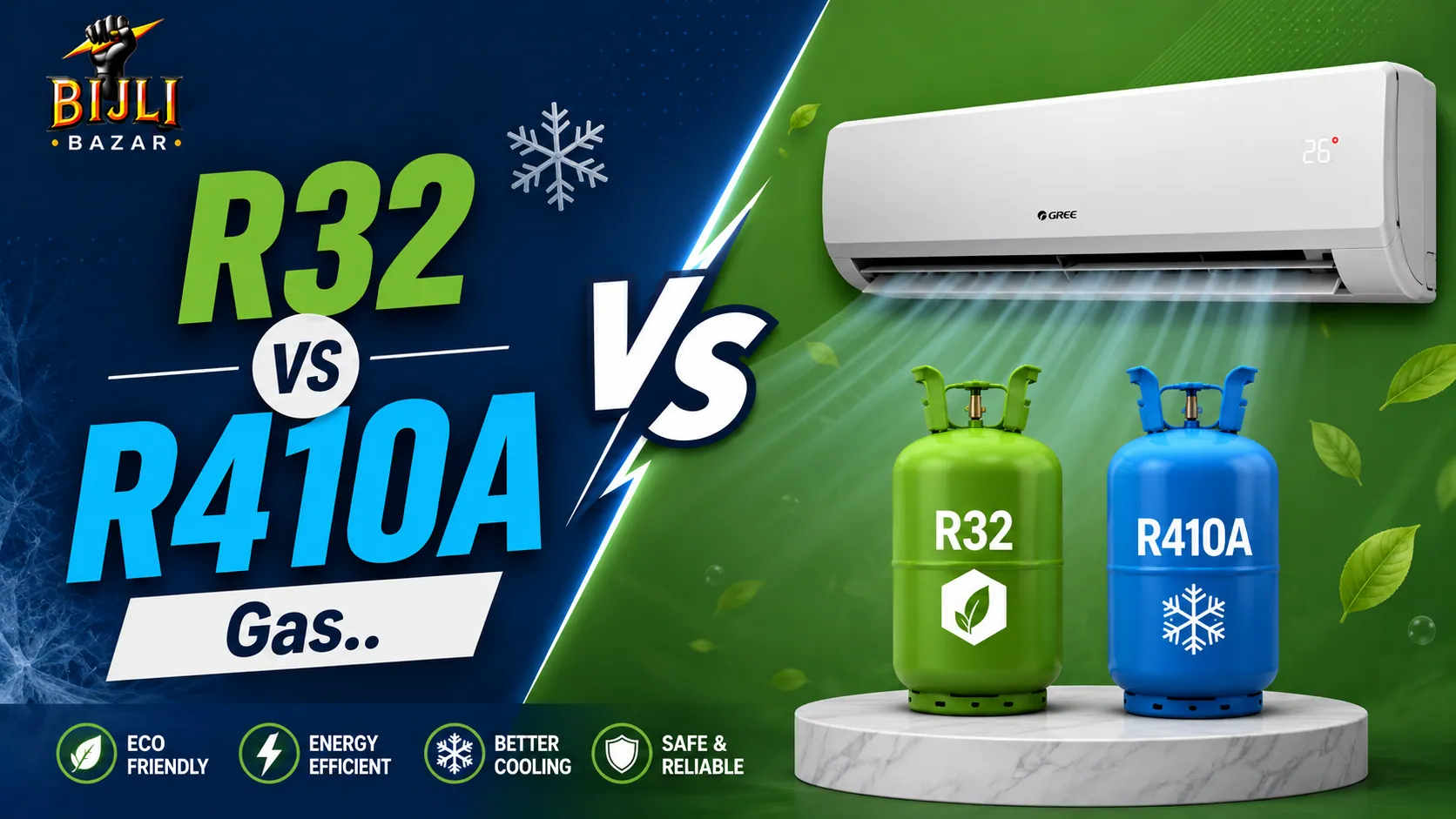
R32 vs R410A Gas: Which Refrigerant is Better for Your Air Conditioner?
Choosing an air conditioner isn’t just about selecting the right brand, tonnage, or price. One important factor that many buyers overlook is the refrigerant gas used inside the AC. The refrigerant directly affects cooling performance, energy efficiency, environmental impact, and even long-term maintenance costs.
Today, most modern air conditioners use either R32 or R410A refrigerant. If you’ve been comparing inverter ACs, you’ve probably seen these names in the specifications and wondered which one is better.
In this detailed guide, we’ll explain the R32 vs R410A Gas comparison in simple English. You’ll learn how these refrigerants work, their advantages and disadvantages, how they affect electricity bills, and which option is more suitable for homes in Pakistan.
Table of Contents
- What is AC Refrigerant Gas?
- How Does AC Refrigerant Work?
- Types of Refrigerant Gases
- What is R410A AC Gas?
- What is R32 AC Gas?
- R32 vs R410A Gas Comparison
- Which Gas Cools Better?
- Which Refrigerant Saves More Electricity?
- Environmental Impact
- Safety Comparison
- Gas Refill Cost in Pakistan
- Which Brands Use R32 and R410A?
- Which Refrigerant Should You Choose?
- FAQs
What is AC Refrigerant Gas?
Refrigerant gas is a special fluid that circulates inside an air conditioner and transfers heat from inside your room to the outdoor environment. Without refrigerant, an AC cannot produce cool air.
Many people think the gas is consumed while the AC is running, but that is not true. Refrigerant moves continuously inside a sealed system. Under normal conditions, it does not decrease or need replacement.
If your AC requires a gas refill, it usually means there is a refrigerant leak that should be repaired before adding new gas.
How Does AC Refrigerant Work?
The refrigerant works together with several important components inside the air conditioner.
These include:
- Compressor
- Condenser Coil
- Expansion Valve
- Evaporator Coil
The cooling cycle works like this:
Step 1: Heat Absorption
Warm air from your room passes over the indoor evaporator coil. The refrigerant absorbs this heat and turns into a low-pressure gas.
Step 2: Compression
The compressor increases the pressure and temperature of the refrigerant.
Step 3: Heat Release
The hot refrigerant travels to the outdoor condenser, where it releases heat into the outside air.
Step 4: Cooling Again
After passing through the expansion valve, the refrigerant cools down and returns to the evaporator to repeat the cycle.
This process continues until your room reaches the desired temperature.
Types of AC Refrigerant Gases: R32 vs R410A Gas
Over the years, air conditioners have used different refrigerants. Some older gases have been phased out because of their environmental impact.
R22 Refrigerant
R22 was once the most common refrigerant in residential air conditioners. However, it damages the ozone layer and is being phased out worldwide. New AC models rarely use R22 today.
Key Points
- Older technology
- High ozone depletion potential
- Becoming difficult and expensive to service
- No longer recommended for new installations
R410A Refrigerant
R410A replaced R22 in many air conditioners because it does not harm the ozone layer. For many years, it became the standard refrigerant for residential and commercial AC systems.
Although R410A still delivers excellent cooling performance, many manufacturers are gradually replacing it with newer refrigerants such as R32.
Features of R410A
- Good cooling efficiency
- Zero ozone depletion potential
- Stable performance in hot weather
- Suitable for inverter and non-inverter ACs
- Widely available in older AC models
Advantages
✔ Reliable cooling performance
✔ Proven technology
✔ Easily available spare parts
✔ Used in millions of air conditioners worldwide
Disadvantages
✖ Higher Global Warming Potential (GWP)
✖ Requires a larger refrigerant charge
✖ Slightly lower energy efficiency than R32
What is R32 Refrigerant?
R32 is a next-generation refrigerant that is becoming increasingly popular in modern inverter air conditioners.
Many leading manufacturers have shifted to R32 because it provides better cooling efficiency while reducing environmental impact.
It transfers heat more efficiently, allowing the compressor to reach the desired temperature faster and consume less energy under similar conditions.
Features of R32
- High cooling efficiency
- Faster heat transfer
- Lower refrigerant charge
- Zero ozone depletion potential
- Lower Global Warming Potential than R410A
- Easier to recycle
Advantages
✔ Better energy efficiency
✔ Faster room cooling
✔ Lower electricity consumption
✔ Environmentally friendly
✔ Requires less refrigerant
✔ Widely used in new inverter AC models
Disadvantages
✖ Mildly flammable (A2L classification), requiring proper installation by trained technicians
✖ Slightly newer technology, so servicing may be less familiar in some areas, though this is becoming less of an issue
R32 vs R410A Gas: Quick Comparison
| Feature | R32 | R410A |
|---|---|---|
| Cooling Efficiency | Excellent | Very Good |
| Energy Efficiency | Higher | Good |
| Heat Transfer | Faster | Good |
| Ozone Depletion Potential | 0 | 0 |
| Global Warming Potential | 675 | 2,088 |
| Refrigerant Quantity Required | Lower | Higher |
| Environmental Impact | Lower | Higher |
| Recycling | Easier | More Complex |
| Used in Latest AC Models | Yes | Mostly Older Models |
| Popular in Pakistan | Increasing | Still Common |
Why Refrigerant Type Matters
Many buyers focus only on the AC brand or tonnage, but the refrigerant also plays an important role in overall performance.
The right refrigerant can contribute to:
- Improved cooling efficiency
- Lower electricity consumption
- Reduced environmental impact
- Better long-term performance
- Compliance with future environmental standards
However, refrigerant is only one part of the equation. Compressor quality, inverter technology, condenser design, and correct installation all have a significant effect on how well an air conditioner performs.
Which Refrigerant Provides Better Cooling?
One of the most common questions buyers ask is whether R32 or R410A provides better cooling. The truth is that both refrigerants can cool your room effectively when used in a well-designed air conditioner. However, there are some important differences.
R32 has a higher heat transfer efficiency than R410A. This means it can absorb and release heat more quickly, allowing the air conditioner to cool the room faster under similar operating conditions.
In Pakistan, where summer temperatures often exceed 45°C, faster heat transfer helps the AC reach the desired temperature more efficiently.
However, refrigerant is only one part of the cooling system. The overall cooling performance also depends on:
- Compressor quality
- Inverter technology
- Copper condenser
- Indoor and outdoor unit design
- Proper installation
- Room insulation
- AC capacity (1 Ton, 1.5 Ton, or 2 Ton)
A high-quality R410A inverter AC can still outperform a poorly designed R32 AC.
Winner for Cooling Efficiency: R32
R32 vs R410A Gas: Which Uses Less Electricity?
Electricity consumption is one of the biggest concerns for homeowners in Pakistan. While the refrigerant itself doesn’t directly determine your electricity bill, it does affect the overall efficiency of the cooling system.
R32 transfers heat more efficiently and requires a smaller refrigerant charge. Because of this, the compressor often works more efficiently, which can help reduce power consumption.
R410A also performs well but generally requires more refrigerant and slightly more energy to achieve the same cooling performance.
Remember that electricity usage also depends on:
- Inverter compressor technology
- SEER (Seasonal Energy Efficiency Ratio)
- Room temperature
- Insulation
- Thermostat settings
- Number of people in the room
- Frequency of door and window openings
Example
A typical 1.5 Ton inverter AC may consume:
| Refrigerant | Approximate Electricity Usage |
|---|---|
| R32 | 1.1–1.6 kWh/hour |
| R410A | 1.2–1.8 kWh/hour |
These are average estimates. Actual consumption varies by brand and model.
Winner for Energy Efficiency: R32
Environmental Impact
Today, manufacturers are not only focusing on cooling performance but also on protecting the environment.
Two important terms are used when comparing refrigerants.
Ozone Depletion Potential (ODP)
ODP measures whether a refrigerant damages the Earth’s ozone layer.
Both refrigerants have:
ODP = 0
This means neither R32 nor R410A harms the ozone layer.
Global Warming Potential (GWP)
GWP measures how much a refrigerant contributes to global warming if it escapes into the atmosphere.
| Refrigerant | Global Warming Potential |
|---|---|
| R32 | 675 |
| R410A | 2,088 |
R410A has more than three times the global warming impact of R32.
This is one of the main reasons many leading AC manufacturers are switching to R32 refrigerant.
Winner for Environmental Protection: R32
Is R32 Refrigerant Safe?
Many people hear that R32 is “flammable” and become concerned. In reality, R32 is classified as an A2L refrigerant, meaning it has low flammability.
Modern air conditioners are designed to use R32 safely. When installed and serviced by qualified technicians, it is considered safe for residential and commercial use.
Millions of homes around the world already use R32 air conditioners without any issues.
To ensure safety:
- Always use certified AC technicians.
- Never attempt to refill refrigerant yourself.
- Follow the manufacturer’s installation guidelines.
Refrigerant Refill Cost in Pakistan
The cost of refilling AC gas depends on several factors, including the AC capacity, refrigerant quantity, brand, and technician’s service charges.
Estimated Gas Refill Charges
| Refrigerant | Estimated Total Cost |
|---|---|
| R32 | Rs. 7,000 – Rs. 11,000 |
| R410A | Rs. 7,500 – Rs. 12,000 |
The total cost may include:
- Leak inspection
- Vacuuming
- Gas charging
- Labor charges
- Minor servicing
Prices can vary by city and service provider.
Typical Refrigerant Quantity
| AC Capacity | Refrigerant Required |
|---|---|
| 1 Ton | 0.6–0.9 kg |
| 1.5 Ton | 0.8–1.2 kg |
| 2 Ton | 1.1–1.5 kg |
If your AC requires frequent gas refills, it usually indicates a refrigerant leak. Simply adding more gas without repairing the leak is only a temporary solution.
Which AC Brands Use R32 Refrigerant?
Many manufacturers now use R32 refrigerant in their latest inverter air conditioners because of its better efficiency and lower environmental impact.
Popular brands offering R32 models include:
- Gree
- Haier
- TCL
- Dawlance
- Orient
- Midea
- Panasonic
- Hitachi
- Kenwood
- AUX
- Hisense
Always check the product specifications before purchasing, as some brands may offer both R32 and R410A models.
Which Brands Still Use R410A?
Although R32 is becoming more common, R410A is still found in:
- Older inverter AC models
- Some non-inverter air conditioners
- Budget-friendly product lines
- Existing residential and commercial systems
Many R410A air conditioners continue to provide reliable performance when properly maintained.
Can You Replace R410A with R32?
No. In most cases, an air conditioner designed for R410A should not be converted to R32.
These refrigerants operate at different pressures and require different system designs. Converting an existing R410A system to R32 is generally not recommended and may void the manufacturer’s warranty.
If you want the benefits of R32, it’s usually better to purchase an AC that is specifically designed for it.
R32 vs R410A Gas: Pros and Cons
Every refrigerant has its own strengths and limitations. Understanding the advantages and disadvantages of both R32 and R410A can help you make an informed decision before purchasing a new air conditioner.
Advantages of R32 Refrigerant
- Higher cooling efficiency
- Better energy savings
- Lower Global Warming Potential (GWP)
- Requires less refrigerant than R410A
- Faster heat transfer
- Easier to recycle and recover
- Commonly used in the latest inverter AC models
- Environmentally friendlier option
Disadvantages of R32 Refrigerant
- Mildly flammable (A2L classification)
- Requires trained technicians for servicing
- Some older AC models are not compatible with R32
Advantages of R410A Refrigerant
- Excellent cooling performance
- Reliable and proven technology
- Widely available in existing AC systems
- Large number of trained technicians
- Spare parts are easily available
Disadvantages of R410A Refrigerant
- Higher Global Warming Potential
- Requires more refrigerant
- Slightly lower energy efficiency than R32
- Gradually being replaced in many new AC models
Common Myths About AC Refrigerant Gas
There are many misconceptions about AC refrigerants. Let’s clear up some of the most common ones.
Myth 1: More Refrigerant Means Better Cooling
Fact:
Adding extra refrigerant does not improve cooling. Too much refrigerant can actually reduce efficiency and may damage the compressor.
Myth 2: AC Gas Finishes After Every Summer
Fact:
Refrigerant is not consumed during normal operation. If your AC needs frequent gas refills, it usually has a leak that must be repaired.
Myth 3: R32 Alone Makes an AC Save Electricity
Fact:
R32 improves system efficiency, but electricity consumption also depends on:
- Inverter technology
- Compressor quality
- Room insulation
- Outdoor temperature
- Thermostat settings
- AC maintenance
Myth 4: R410A Is No Longer Usable
Fact:
R410A is still widely used in many air conditioners and continues to provide reliable cooling. However, many manufacturers are now introducing R32 in their newer product lines.
Myth 5: Any Technician Can Change Refrigerant Type
Fact:
Switching from R410A to R32 is generally not recommended because both systems are designed differently and operate under different conditions.
Myth 6: Refrigerant Determines Everything
Fact:
A refrigerant is only one part of the cooling system. The compressor, condenser, evaporator, expansion valve, and overall AC design have a significant impact on performance.
Which Refrigerant Should You Choose?
Choosing between R32 and R410A depends on your needs and budget.
Choose an R32 Air Conditioner if You Want:
- Lower electricity bills
- Faster cooling
- Latest inverter technology
- Lower environmental impact
- Better long-term investment
- Modern energy-efficient performance
Choose an R410A Air Conditioner if:
- You’re replacing an existing R410A system
- You find a quality model at a competitive price
- After-sales service and spare parts are readily available
- The AC offers excellent specifications despite using R410A
For most buyers purchasing a new air conditioner, R32 is generally the better option because it combines efficient cooling with lower environmental impact.
Buying Guide: Things to Check Before Buying an AC
The refrigerant type is important, but it shouldn’t be your only consideration. Before buying an air conditioner, compare these factors:
- Inverter or Non-Inverter Technology
- Cooling Capacity (1 Ton, 1.5 Ton, 2 Ton)
- Energy Efficiency Rating (EER/SEER)
- Refrigerant Type (R32 or R410A)
- Compressor Warranty
- Copper Condenser
- T3 Compressor (for extreme heat if needed)
- Smart Features (Wi-Fi, App Control)
- Noise Level
- After-Sales Service
- Availability of Spare Parts
- Brand Reputation
A balanced comparison helps you choose an AC that delivers better value over the long term.
Frequently Asked Questions (FAQs)
1. Which AC gas is better, R32 or R410A?
For most new air conditioners, R32 is considered the better option because it offers higher energy efficiency, lower Global Warming Potential, and requires less refrigerant.
2. Does R32 cool faster than R410A?
Yes. R32 has better heat transfer properties, which can help the AC cool a room more quickly under similar conditions.
3. Which refrigerant is more environmentally friendly?
R32 is more environmentally friendly because it has a much lower Global Warming Potential than R410A, while both have zero Ozone Depletion Potential.
4. Does R32 reduce electricity bills?
R32 can improve overall system efficiency, but actual electricity savings depend on the compressor, inverter technology, room conditions, and usage habits.
5. Is R32 safe for home use?
Yes. R32 is safe when installed and serviced by qualified technicians according to the manufacturer’s guidelines.
6. Can I replace R410A with R32?
No. Most R410A air conditioners are not designed to operate with R32, so conversion is generally not recommended.
7. Does AC refrigerant get used up over time?
No. Refrigerant circulates inside a sealed system and does not get consumed during normal operation. If the level drops, there is likely a leak.
8. How often should AC gas be refilled?
There is no regular refill schedule. A properly functioning air conditioner should not require additional refrigerant unless there is a leak.
9. Which AC brands use R32 refrigerant?
Many modern models from brands such as Gree, Haier, TCL, Dawlance, Midea, Panasonic, Orient, and Kenwood use R32 refrigerant.
10. Is R410A still a good choice?
Yes. R410A still provides effective cooling and is used in many existing air conditioners. However, R32 is becoming the preferred refrigerant in newer models.
11. Does refrigerant type affect AC lifespan?
The refrigerant itself does not determine lifespan. Proper installation, regular maintenance, and compressor quality are more important.
12. Which refrigerant is better for Pakistan’s hot weather?
Both R32 and R410A perform well in high temperatures. However, many modern R32 inverter air conditioners offer better efficiency during long summer seasons.
Final Verdict
When comparing R32 vs R410A Gas, both refrigerants are capable of providing excellent cooling performance. However, R32 stands out as the more advanced choice for modern air conditioners. It delivers better energy efficiency, faster heat transfer, requires less refrigerant, and has a significantly lower environmental impact than R410A.
That said, refrigerant type should not be the only factor when choosing an air conditioner. Compressor technology, inverter performance, energy efficiency rating, build quality, warranty, and reliable after-sales service are equally important. A well-designed R410A air conditioner can still perform exceptionally well, while a poorly built R32 model may not meet expectations.
If you’re planning to buy a new air conditioner, an R32 inverter AC is generally the better long-term investment for most households in Pakistan. It offers a good balance of cooling performance, energy savings, and environmental responsibility.
At Bijli Bazar, you can explore a wide range of inverter air conditioners from trusted brands like Gree, Haier, Dawlance, TCL, Orient, Midea, Panasonic, Kenwood, and more. Compare features, refrigerant types, and prices to choose the AC that best suits your home and budget.